Legal Guide · Car Accident
What To Do After a Car Accident
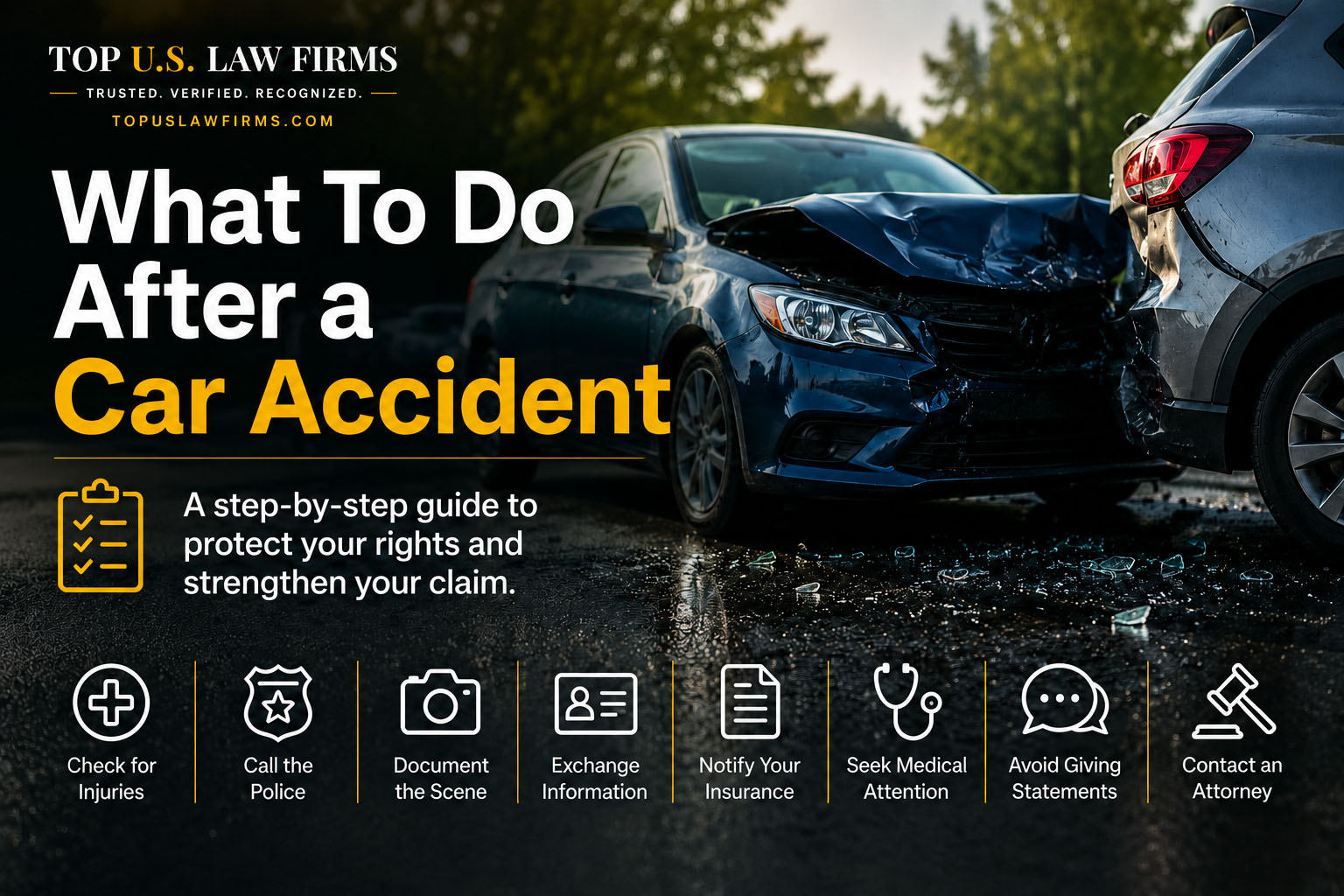
Step-by-Step Guide to Protect Your Rights and Strengthen Your Claim
Featured Guide • Personal Injury • Approximately 6 Minute Read
What You'll Learn
✔ How to stay safe after a collision
✔ What information you should collect
✔ Which photographs matter most
✔ How medical treatment can protect both your health and your claim
✔ Common mistakes that can weaken an insurance or legal claim
✔ When to consider contacting a personal injury attorney
Quick Action Checklist
If you're standing at the scene of an accident, start here.
| ✓ Do This Immediately |
| □ Check everyone for injuries |
| □ Move vehicles to safety (if possible) |
| □ Call 911 |
| □ Exchange insurance information |
| □ Photograph the accident |
| □ Gather witness information |
| □ Seek medical attention |
| □ Notify your insurance company |
| □ Save every accident-related document |
Before You Begin
No one expects to be involved in a car accident. Whether it's a minor fender bender or a serious collision,
the first few hours afterward can have a lasting impact on your health, your insurance claim,
and your legal rights. This guide walks you through the most important steps to take immediately after an accident, the mistakes to avoid, and when it may be appropriate to speak with a personal injury attorney.
Step 1
Stay Safe First
Your first responsibility is protecting yourself and everyone else involved.
If your vehicle can be moved safely, pull off the roadway and turn on your hazard lights. Check yourself and your passengers for injuries before worrying about the damage to your vehicle.
If someone appears seriously injured, avoid moving them unless they are in immediate danger.
Why This Matters
Secondary crashes frequently occur after the initial collision. Moving to a safe location helps prevent additional injuries.
Step 2
Call 911
Even if the accident appears minor, contact law enforcement.
A responding officer can document the scene and prepare an official accident report that may later become important evidence.
While Waiting
- Stay calm.
- Cooperate with officers.
- Provide factual information.
- Ask how to obtain the police report.
Pro Tip
A police report often becomes one of the most valuable pieces of documentation during an insurance claim.
Step 3
Get Medical Attention
Some injuries don't appear immediately.
Whiplash, concussions, soft tissue injuries, and internal injuries may not become noticeable until several hours—or even days—after the accident.
Your Medical Timeline
Immediately
- Accept emergency treatment if recommended.
Within 24 Hours
- Schedule a medical evaluation if you were not transported from the scene.
Following Days
- Monitor symptoms.
- Follow all treatment recommendations.
- Keep every medical record.
Why It Matters
Prompt medical care protects your health while creating important documentation should a personal injury attorney later need to demonstrate how the accident affected your life.
Step 4
Exchange Information
Collect the following from every driver involved.
| Driver Information |
| ✓ Full Name |
| ✓ Driver's License Number |
| ✓ Phone Number |
| ✓ Insurance Company |
| ✓ Policy Number |
| ✓ Vehicle Registration |
| ✓ License Plate Number |
Remain polite throughout the conversation.
Avoid Discussing
✘ Who caused the accident
✘ Whether you think you're injured
✘ Who should pay
Fault should never be decided roadside.
Step 5
Document Everything
Your smartphone is one of the most valuable tools you have after an accident.
Photograph
📷 Every vehicle
📷 Vehicle damage
📷 The overall accident scene
📷 Traffic signals
📷 Road conditions
📷 Skid marks
📷 Weather conditions
📷 Visible injuries
Also Collect
- Witness names
- Witness phone numbers
- Time of accident
- Exact location
Pro Tip
It's almost impossible to take too many photographs.
Step 6
Notify Your Insurance Company
Report the accident promptly.
Stick to the facts.
Avoid guessing about:
- Speed
- Fault
- Injuries
- What another driver was thinking
If your injuries become significant or liability is disputed, a personal injury attorney can later help guide communications with the insurance company.
Step 7
Save Every Record
Create one folder dedicated to your accident.
Include:
- Police report
- Medical bills
- Medical records
- Repair estimates
- Rental car receipts
- Prescription expenses
- Insurance correspondence
- Lost wage documentation
- Photographs
Good organization today can prevent major headaches later.
Common Mistakes That Hurt Claims
⚠ Avoid These Common Errors
Don't Leave the Scene
Remain until law enforcement says you're free to leave.
Don't Admit Fault
Even saying "I'm sorry" can later be misunderstood.
Don't Argue
Stay professional.
Arguments rarely help and often make situations worse.
Don't Delay Medical Care
Waiting several days may affect both your recovery and your claim.
Don't Give Recorded Statements Too Quickly
Understand why an insurance company wants a recorded statement before agreeing.
Don't Rush Into a Settlement
Early settlement offers may not reflect the full cost of your injuries.
Don't Post About the Accident
Photos and comments posted online may later become evidence.
Quick Reference Card
✔ DO
✅ Stay Safe
✅ Call 911
✅ Exchange Information
✅ Photograph Everything
✅ Get Medical Care
✅ Notify Insurance
✅ Save Every Record
✅ Contact a personal injury attorney if injuries are serious
✘ DON'T
❌ Leave the Scene
❌ Admit Fault
❌ Argue with Other Drivers
❌ Delay Medical Treatment
❌ Give Unnecessary Recorded Statements
❌ Accept the First Settlement Offer
❌ Discuss the Accident on Social Media
When Should You Contact a Personal Injury Attorney?
Speaking with a personal injury attorney may be beneficial if:
✔ You suffered serious injuries.
✔ Liability is disputed.
✔ Multiple vehicles were involved.
✔ Your insurance claim was denied.
✔ You received a settlement offer that seems too low.
✔ You missed work because of your injuries.
✔ Your medical bills continue to grow.
Many personal injury attorneys offer free consultations, giving you the opportunity to better understand your legal rights before making any decisions.
Final Thoughts
A car accident can leave you feeling overwhelmed, but taking the right steps immediately afterward can make a meaningful difference. Prioritizing safety, seeking prompt medical care, documenting the scene thoroughly, and avoiding common mistakes can help protect both your health and your legal rights.
If your accident resulted in significant injuries, disputed liability, or an insurance company that is unwilling to offer fair compensation, speaking with an experienced personal injury attorney can help you better understand your options and move forward with confidence.
Related Guides
- Understanding Insurance Claims After an Accident
- How Settlement Values Are Determined
- Questions to Ask Before Hiring a Personal Injury Attorney
- Medical Documentation After a Car Accident
- What Happens During a Personal Injury Lawsuit?